
 Enquire Now
 Contact Us
  1300 486 252
The mill that never sleeps
The Mill That Never Sleeps
When Alliance Dental Laboratories invested in the Ivoclar PrograMill PM7, they didn’t just upgrade their equipment – they unlocked a 24/7 production capability that has redefined what a 40-year-old lab can achieve.
By Danny Chan
There’s a particular breed of dental professional for whom the phrase “good enough” simply doesn’t compute. Nick Monaco, Director of Alliance Dental Laboratories, is one of them.
Armed with over four decades of precision craftsmanship, Alliance has long been defined by meticulous in-house production, advanced CAD/CAM and a fully digital denture workflow.
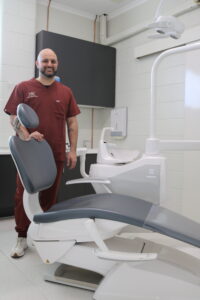
With the recent installation of the Ivoclar PrograMill PM7 and a Stern Weber dental chair – ahead of the lab’s upcoming 2026 launch of the Monaco Denture Clinic – the operation has decidedly shifted into a different gear.
Craft first, technology second
In an industry that sometimes obsesses over the latest hardware, Alliance takes a more considered view.
“Our philosophy has always been simple,” Monaco says. “Technology should enhance craftsmanship, not replace it. We don’t adopt new technology for the sake of it. Every piece of equipment, every material, and every workflow we introduce has to serve a clear purpose: improving consistency, precision, and ultimately, patient outcomes.”
This philosophy extends beyond just their laboratory equipment to the clinical environment they’re building. When asked what drew them to the Stern Weber chair, Monaco explains, “We were drawn to Stern Weber for its blend of reliability, precision, and modern design. It aligns perfectly with the digital, patient-focused environment we’ve built at Alliance, complementing our workflows and reflecting the same standard of quality across all aspects of care.”
As demand for digital dentures and full-arch restorations accelerated, the team faced a pivotal decision – one that would ultimately lead them to the PM7.
“The growing demand for All-on-X restorations, zirconia bridges, and digitally produced dentures has had a direct impact on how we invest in equipment and structure our workflows,” Monaco explains. “These types of cases require a level of precision, strength, and repeatability that simply isn’t achievable without the right digital infrastructure in place.”
The answer wasn’t just any mill. It was the mill that could, performance-wise, hit the ground running yet future-proof enough to serve the lab’s long-term strategy.
The mill that changed everything
Monaco is candid about what first attracted him to the PrograMill PM7. The lab’s immediate need was focused: improving and scaling the digital denture workflow.
“We wanted a system that could deliver consistent, high-quality milled dentures with minimal manual intervention,” he recalls, “and the PM7 gave us that level of reliability and precision straight away.”
What he didn’t fully anticipate was how quickly the unit would outgrow its original brief.
“What stood out to me straight away was how much more the unit was capable of beyond that initial purpose. The 8-way material changer, in particular, was a major factor. It allows us to load multiple discs and run different indications back-to-back without needing constant oversight. That’s enabled us to effectively run the mill 24/7, which has completely changed our production capacity.”
That last phrase – run the mill 24/7 – is not hyperbole. It’s one of the more striking operational realities to emerge from Alliance’s experience with the PM7. With the disc changer and automation working in tandem, jobs are queued and run overnight, across weekends, without additional labour costs or supervision.
“We’re no longer limited to standard working hours,” Monaco notes. “That’s allowed us to deliver cases faster while still maintaining our quality standards.”
Precision you can see
Beyond throughput, the PM7 has delivered something harder to quantify but equally valuable: predictability.
“From a production standpoint, the biggest shift has been consistency – once a job is set up, we know it’s going to mill accurately every time,” Monaco says. “That level of predictability removes a lot of the variability we used to account for, especially with more complex full-arch and implant cases.”
Surface quality, too, has registered a marked improvement. The finish off the mill is cleaner, more refined – free from the processing errors that can occur during traditional packing or injection methods.
“Denture finishing is now as simple as cutting off the sprues and polishing,” Monaco says. “Once removed from the mill, the denture is finished within 10 minutes.”
The PM7’s autonomous features – automatic tool changing, RFID material management, self-cleaning – have compounded these gains in a way that’s hard to overstate.
“Those autonomous features have made a measurable difference,” Monaco affirms. “They allow us to run the mill with minimal supervision, increasing output, improving consistency, and freeing up our team to focus on higher-value work.”
Ask which single feature has surprised him most, and the answer comes without hesitation.
“The disc changer,” Monaco says. “The PM7 is the first mill in our lineup with this capability and we will never go back to a manually loaded mill.”
Word to the wise
For labs or practices weighing a similar investment, Monaco’s advice is grounded and unambiguous.
“Focus on long-term value rather than upfront cost,” Monaco advises. “Equipment like a high-end mill should improve efficiency, consistency, and scalability.” For Alliance, leasing the PM7 proved the smarter financial move – preserving cash flow while incorporating servicing into the arrangement and eliminating the spectre of unexpected costs.
“Make sure the technology genuinely fits your workflow and growth plans, not just current needs,” he adds. “The right investment should pay for itself through increased productivity, reduced remakes, and the ability to take on more advanced, higher-value work.”
As Alliance looks ahead to the 2026 launch of the Monaco Denture Clinic – a dedicated, fully digital denture experience integrated within the laboratory itself – it’s clear that the PM7 isn’t just a piece of equipment. It’s a statement of intent.
For a lab that has spent 40 years refusing to compromise on quality, that’s entirely on brand.